


News
Fewer Farms Contribute to Data Concerns
Farm groups and market analysts have been raising concerns recently that USDA’s outdated methods for data collection and analysis could be distorting what’s happening on the ground. Moreover, because the data in some of USDA’s reports, such as the World Agricultural Supply and Demand Estimates, Crop Production, and January and July Cattle reports, are benchmarks used in other agricultural forecasts, reality could be further skewed, according to Mary Ledman, analyst with the Daily Dairy Report.
Secretary of Agriculture Brooke Rollins recently issued a Request for Information (RFI) in the Federal Registeras it considers ways to improve its reporting. The RFI includes a 45‑day comment period, ending April 9, and USDA plans to discuss the feedback it receives at its 2026 spring data users meeting on April 22 in Kansas City, Missouri.
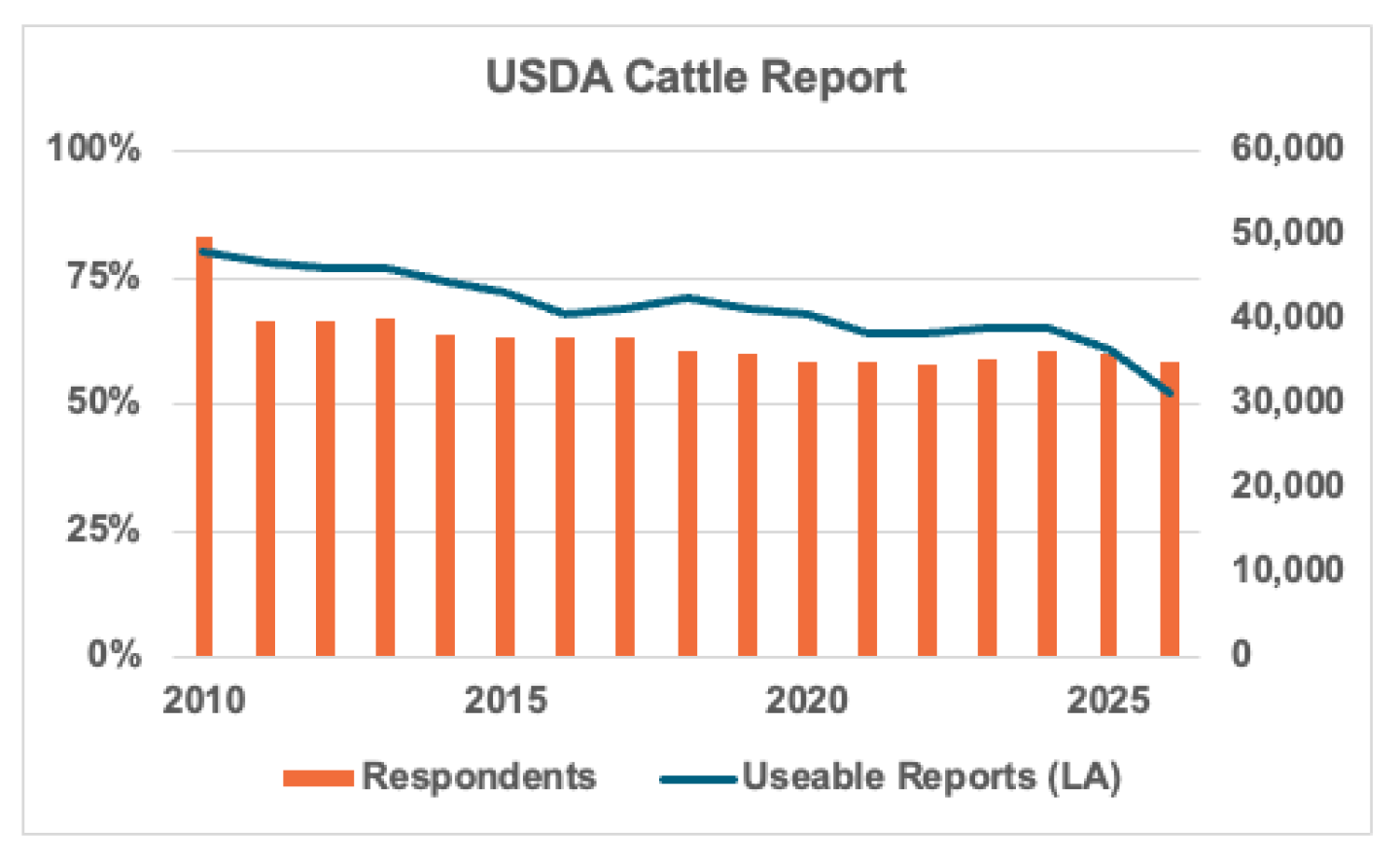
“USDA relies on farmers and livestock producers for survey contributions, and declining participation in these surveys puts more of the estimation burden on USDA statisticians and economists,” Ledman said. To see whether declining participation could be skewing the data, Daily Dairy Report reviewed response rates for USDA’s Cattle report, a biannual inventory of all cattle and calves, Ledman added.
Ledman chose to look at the Cattle report because it has become increasingly important to the dairy sector in recent years as the primary indicator of the number of replacement heifers available to enter the national milk herd. Her analysis shows that for the past three years, 2024, 2025, and 2026, the January Cattle report put the number of replacement heifers at about 3.9 million head, compared with 4.7 million head in 2019. The largest year‑over‑year decline of 367,000 head occurred in 2023, followed by a 168,000‑head drop in 2022. The staggering declines caused Ledman to question whether they were related to lower survey response rates.
(USDA)
“USDA derives its Cattle estimates by surveying a random sample of U.S. producers. The procedures ensure that all cattle operations, regardless of size, have a chance to be included, and large operations are sampled more heavily than small ones,” she noted. “In the first half of January, USDA collected data from about 35,000 operators using mail, phone, internet, and in‑person interviews. When the sampling was over, only 52% of the reports were usable, she noted. That compares with last year, when the department collected data from about 36,100 operators and 61% of the reports were usable. It also falls well below the 80% of reports that were usable taken from 50,000 operators in 2010.”
The decline in the number of licensed dairy operations has contributed to fewer survey responses. In 2010, more than 53,000 licensed dairy farms were in operation. Fifteen years later, that number had dropped to 23,609, according to USDA data.
Not surprisingly, some of the biggest declines in dairy operations occurred in states with the largest number of dairy farms,” Ledman said. “Between 2020 and 2025, dairy farm numbers declined by 8,043 operations, with Wisconsin accounting for 22% of the drop, followed by Pennsylvania at 13%, New York with 11%, and Minnesota at 9%. These states are also home to the largest numbers of dairy farms with fewer than 500 cows — the size category that has experienced the steepest decline in recent years and that historically has produced surplus heifers.”